25 Back to School Ice Breakers That Work (2026, K-12)
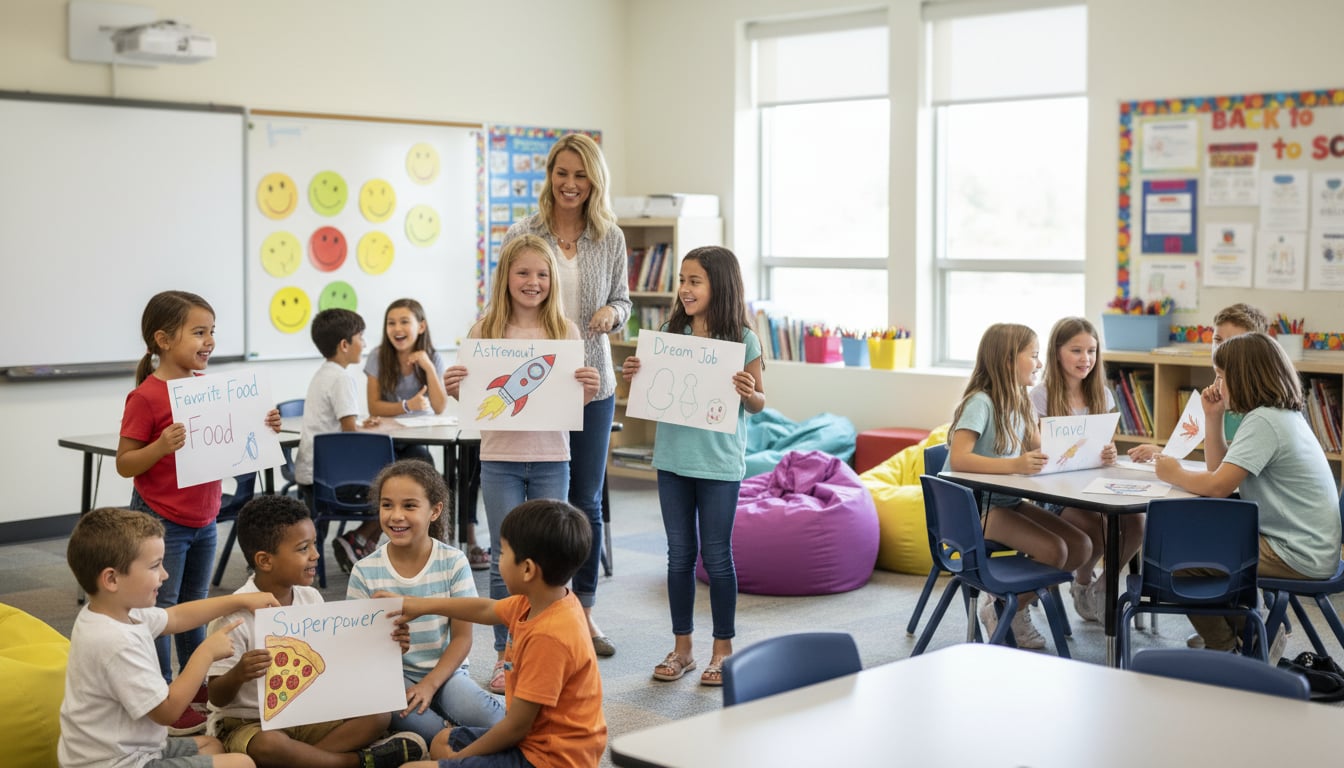
TL;DR: Most back to school ice breakers fail because they force students to be vulnerable with people they barely know. This guide covers 25 teacher-tested activities organized by grade level (K-5, 6-8, 9-12), each evaluated against an original “Cringe Test” framework. Every activity is low-prep or no-prep, takes under 20 minutes, and has been validated by real classroom practitioners. Use the comparison table below to find the right icebreaker for your students in seconds.
Why First-Day Icebreakers Matter More Than You Think
The first day of school is a paradox. You want to build community, but students are scanning the room for threats, not friendships. This isn’t a metaphor. According to Dr. Bruce Perry, a leading expert in child development and neuroscience, students must feel emotionally secure before they can fully engage in academic tasks. The brain’s limbic system, which governs emotions and social connections, is tightly linked to the prefrontal cortex, the region responsible for problem-solving and higher-order thinking.
The practical implication: if a student feels anxious or socially threatened, the academic part of their brain is essentially offline. Effective back to school ice breakers address this directly. They stimulate dopamine release (the neurotransmitter associated with motivation and engagement), which research by Willis (2011) connects to both improved mood and readiness to learn. And when students experience a genuine sense of belonging, Dr. John Hattie’s research identifies it as a key factor in academic achievement.
So icebreakers aren’t fluff. They are the neurological on-ramp to everything else you want to accomplish that year. The question is which ones actually work, and which ones make students want to disappear. If you’re looking for broader strategies to improve student achievement, the connection between belonging and performance is the place to start.
At-a-Glance: All 25 Activities Compared
Elementary (K-5)
| # | Activity | Best Grades | Prep | Time | Type | Printable? |
|---|---|---|---|---|---|---|
| 1 | In the Middle | K-2 | None | 10 min | Movement | No |
| 2 | Superpower Paper Dolls | K-2 | Low | 15 min | Creative | No |
| 3 | Classmate Bingo | 2-5 | Low | 15-20 min | Movement/Social | Yes |
| 4 | Would You Rather (Thumbs Up) | K-5 | None | 10 min | Movement | No |
| 5 | Pipe Cleaner Facts | 1-4 | Low | 15 min | Creative | No |
| 6 | Book Jacket About Me | 3-5 | Low | 20 min | Creative/Writing | No |
| 7 | Play Dough Creations | K-1 | Low | 15 min | Creative | No |
| 8 | Three-Word Story | 2-5 | None | 10 min | Social | No |
| 9 | Who’s in Your Circles? | 3-5 | Low | 15 min | Social/Writing | Yes |
Middle School (6-8)
| # | Activity | Best Grades | Prep | Time | Type | Printable? |
|---|---|---|---|---|---|---|
| 1 | Blobs and Lines | 3-8 | None | 10-15 min | Movement | No |
| 2 | Speed Greetings | 6-8 | None | 15 min | Social | No |
| 3 | Never Have I Ever (PG) | 5-8 | None | 10 min | Movement | No |
| 4 | Class Playlist | 5-8 | Low | 15 min | Creative/Social | No |
| 5 | Snowball Fight | 5-8 | Low | 15 min | Movement/Social | No |
| 6 | Switch Drawing | 6-8 | Low | 15 min | Creative | No |
| 7 | Four Corners (Digital Option) | 5-8 | Low | 10-15 min | Movement/Discussion | No |
High School (9-12)
| # | Activity | Best Grades | Prep | Time | Type | Printable? |
|---|---|---|---|---|---|---|
| 1 | Pop Quiz About the Teacher | 6-12 | Medium | 15 min | Discussion | Yes |
| 2 | Boring Facts | 7-12 | None | 10 min | Social | No |
| 3 | Say It in Six | 7-12 | None | 10 min | Creative/Writing | No |
| 4 | Emoji Introduction | 8-12 | None | 10 min | Creative | No |
| 5 | Vision Boards | 9-12 | Medium | 20-30 min | Creative | No |
| 6 | Two Truths and a Lie (Revised) | 6-12 | None | 15 min | Social | No |
| 7 | Classroom Scavenger Hunt | 9-12 | Medium | 20 min | Movement/Social | Yes |
| 8 | Venn Diagram Pairs | 9-12 | Low | 15 min | Social/Writing | Yes |
| 9 | Story Behind Your Name | 9-12 | None | 10 min | Discussion | No |
The Cringe Test: What Makes a Back to School Icebreaker Work or Backfire
As one classroom management specialist at The Unteachables puts it: “We’re told those first lessons are crucial, and they are, but let’s be real: a few cringey icebreaker games aren’t going to magically build a class culture.” The problem isn’t icebreakers themselves. It’s that too many of them demand social risks students aren’t ready to take. Cult of Pedagogy notes that traditional icebreakers often “require students to take big social risks with people they barely know,” or they’re “just plain cheesy.”
Before picking any activity from this list, run it through the Cringe Test. An icebreaker passes if it meets these criteria:
Green flags:
- Low individual spotlight (no one is forced to perform solo)
- Movement-based or hands-on (bodies in motion, not just talking heads)
- The teacher participates too
- Works for both introverts and extroverts
- Takes under 15 minutes
Red flags:
- Forced vulnerability with strangers (“Share your deepest fear!”)
- One person stuck in the center of attention
- Only rewards outgoing personalities
- Requires extensive self-disclosure on day one
The Unteachables offers three additional criteria that practitioners keep echoing: (1) it should be fun for the teacher too, (2) if it’s cheesy, lean all the way into the cheese, and (3) it should open the door for low-pressure discussion, not forced intimacy. Every activity below has been filtered through this framework.
Elementary School Ice Breakers (Grades K-5)
Explore 23+ free AI tools for teachers
Browse All Tools →Young students need movement, sensory engagement, and simple rules. These first-day icebreaker activities keep the energy high and the social risk low.
1. In the Middle
Best for: K-2 classrooms building group identity on day one
Prep: None | Time: 10 min
Students stand in a circle. The teacher calls out prompts (“Step into the middle if you have a pet,” “Step in if you like pizza”), and everyone who relates steps forward, looks around, then steps back. No one speaks. No one is singled out. The shared movement creates an instant feeling of “me too” without anyone having to talk in front of the group. Start with universal prompts before getting more specific.
2. Superpower Paper Dolls
Best for: K-2 students who need a creative, hands-on warm-up
Prep: Low (paper, crayons) | Time: 15 min
Each student gets a paper doll outline and decorates it to show their “superpower,” which can be anything from being a fast runner to being nice to animals. Display them on a bulletin board. The beauty here is that students control what they share, and the creative task gives anxious kids something to focus on besides the social situation.
3. Classmate Bingo
Best for: Grades 2-5 where students need a reason to approach each other
Prep: Low (bingo cards) | Time: 15-20 min
Each square on the bingo card contains a statement like “has a younger sibling” or “has been on an airplane.” Students move around the room getting classmates to sign squares that apply to them. First to complete a row wins. Practitioners on the OER Project teacher forum report that Classroom Bingo with candy prizes consistently works, with one student describing it as “it doesn’t suck,” which is high praise from a middle schooler. It works just as well with younger students. If you don’t want to design cards from scratch, TeachTools has a bingo card generator that creates custom cards in minutes.
4. Would You Rather (Thumbs Up)
Best for: K-5, especially mixed-age or combined classrooms
Prep: None | Time: 10 min
The teacher poses “Would you rather” questions (fly or be invisible? pizza or tacos?), and students respond with thumbs up for option A, thumbs down for option B. No standing up, no walking around, no speaking required. This is one of the safest icebreakers for anxious students because participation is nearly invisible. It works across every grade level, though older students may want the questions to be more creative.
5. Pipe Cleaner Facts
Best for: Grades 1-4 who enjoy tactile activities
Prep: Low (pipe cleaners) | Time: 15 min
Give each student three pipe cleaners. They bend each one into a shape representing something about themselves (a soccer ball, the letter of their name, a cat). Then they share with a partner or small group. The physical object gives students something to hold and talk about, which reduces the pressure of eye contact and direct questioning.
6. Book Jacket About Me
Best for: Grades 3-5, especially in ELA classrooms
Prep: Low (folded paper) | Time: 20 min
Students fold a piece of paper into a book jacket. The front cover is their “title” (their name and an illustration). The back has “reviews” from people who know them (real or imagined). The inside flap has an “author bio.” This is a strong choice for building writing-classroom culture from day one, and finished jackets make an immediate bulletin board display.
7. Play Dough Creations
Best for: K-1 students still developing verbal skills
Prep: Low (play dough) | Time: 15 min
Students sculpt something that represents them or something they love. Then they do a gallery walk. This is purely sensory and creative, with zero public speaking pressure. It works especially well for kindergartners on their very first day, when some students are still working up the courage to talk at all.
8. Three-Word Story
Best for: Grades 2-5, quick energy builder
Prep: None | Time: 10 min
Sitting in a circle, each student adds exactly three words to an unfolding story. The results are always absurd, which is the point. The constraint (only three words) makes participation feel safe because no one is responsible for the whole narrative. The silliness builds shared laughter without shared vulnerability.
9. Who’s in Your Circles?
Best for: Grades 3-5, early community mapping
Prep: Low (worksheet) | Time: 15 min
Students get a sheet with concentric circles. In the center, they write their name. In the next ring, family. Then friends, hobbies, and “things I want to learn.” Students walk around finding classmates who share items in any ring and write their names there. This works as both an icebreaker and a soft getting-to-know-you worksheet, and you can use a worksheet generator to customize the prompts for your class.
Middle School Ice Breakers (Grades 6-8)
Middle school is the danger zone for icebreakers. Students are hyper-aware of social hierarchies, terrified of looking foolish, and masters at detecting anything fake. The best icebreakers for this age group keep the spotlight low, the movement high, and the cheese fully acknowledged.
1. Blobs and Lines
Best for: Grades 3-8, especially self-conscious middle schoolers
Prep: None | Time: 10-15 min
The teacher calls out a category (“line up by birthday month” or “blob together if you’re a dog person”). Students physically move into lines or clusters without assigned spots. Cult of Pedagogy highlights this as a top pick, and a teacher in their comments tested it with 6th graders, reporting it was “very successful” with “lots of laughter and connection.” It works because the movement is the interaction. There’s no scripted sharing, no spotlight. Students discover commonalities organically just by standing near each other.
2. Speed Greetings
Best for: Grades 6-8, building broad-but-shallow connections fast
Prep: None | Time: 15 min
Students form two lines facing each other. They get 30 seconds to exchange names and answer one question (posted on the board), then one line shifts. Think speed dating, minus the dating. The time pressure actually helps because it eliminates awkward silence, and every conversation is mercifully brief. Change the question each round.
3. Never Have I Ever (PG Edition)
Best for: Grades 5-8, high energy and physical
Prep: None | Time: 10 min
Students hold up ten fingers. The teacher (or students) make “never have I ever” statements. If you’ve done the thing, you lower a finger. Keep it clean and light: “Never have I ever eaten sushi,” “Never have I ever been to a concert.” The key is vetting the prompts. Teacher-provided prompts keep it safe for the first round, then you can open it up once you’ve modeled appropriate examples.
4. Class Playlist
Best for: Grades 5-8, music-loving groups
Prep: Low (shared document or paper) | Time: 15 min
Each student contributes one song to a class playlist (on a shared Google Doc, Spotify, or simply on index cards). The playlist becomes background music for independent work throughout the first week. This icebreaker shows up independently across multiple teacher sources, from The Unteachables to City Teaching Alliance to Bored Teachers, which signals it’s a genuine classroom winner. Students feel seen when their song plays, and it opens low-stakes conversation (“Oh, you like that song too?”).
5. Snowball Fight
Best for: Grades 5-8, anonymous sharing with movement
Prep: Low (paper) | Time: 15 min
Students write a fun fact about themselves on a piece of paper (no names), crumple it into a “snowball,” and toss it across the room for 30 seconds. Everyone picks up a snowball, reads it aloud, and the group guesses who wrote it. The anonymity is what makes this work for middle school. Students reveal things about themselves without the vulnerability of direct disclosure.
6. Switch Drawing
Best for: Grades 6-8, creative collaboration
Prep: Low (paper) | Time: 15 min
Each student starts a drawing (prompted or free), then passes it to the next person every 60 seconds. By the end, every paper has contributions from six or seven students. Teacher Freda Anderson on the OER Project forum recommends this activity because it “shows collaboration in a sort of metaphorical way, how a new idea can be created from the ideas of many.” It’s hands-on, low-verbal, and produces a tangible artifact students can laugh about together.
7. Four Corners (with Digital Option)
Best for: Grades 5-8, flexible and adaptable
Prep: Low | Time: 10-15 min
Label each corner of the room with a choice (favorite season, preferred superpower, etc.). Students physically walk to their corner, discuss briefly, then regroup for the next question. For a modern twist, Bored Teachers recommends using Mentimeter, Kahoot, or Google Forms so students can respond digitally instead of physically moving. The digital version works well for students who find public movement stressful, while the physical version gets energy flowing.
High School Ice Breakers (Grades 9-12)
High schoolers are the hardest audience for first-day activities. They’ve sat through years of cringeworthy icebreakers and their defenses are up. The activities that work at this level share one trait: they preserve dignity. No one should feel childish, exposed, or patronized.
1. Pop Quiz About the Teacher
Best for: Grades 6-12, especially first-year teachers building rapport
Prep: Medium (quiz handout) | Time: 15 min
Walk in on day one and announce: “Pop quiz.” Watch the panic. Then reveal the quiz is about you, the teacher. Questions like “How many siblings does Ms. Garcia have?” or “What’s Mr. Chen’s hidden talent?” Students guess, then you reveal the real answers. Edmentum highlights this as a standout activity because it flips the vulnerability dynamic: students feel safe learning about the teacher before being asked to share about themselves. You can build the quiz handout quickly with a quiz generator and export it as a print-ready PDF.
2. Boring Facts
Best for: Grades 7-12, groups resistant to traditional icebreakers
Prep: None | Time: 10 min
Instead of sharing something interesting about themselves, students share the most boring fact possible. “Hi, I’m Anna, and I can walk.” “I’m Marcus, and I own a backpack.” City Teaching Alliance calls this one “hilarious” because it “takes the pressure off.” The anti-icebreaker icebreaker. Students who dread sharing something personal or impressive find it liberating to compete for maximum mundanity. It reliably produces real laughter without requiring real disclosure.
3. Say It in Six
Best for: Grades 7-12, ELA and creative writing classrooms
Prep: None | Time: 10 min
Students tell a story about their summer, their life, or anything at all in exactly six words. (“Moved again. New school. Same lunch.”) The constraint makes this feel like a creative challenge rather than a sharing exercise. City Teaching Alliance highlights it as a high-creativity, low-exposure option. Students can share with a partner first, then volunteers can share with the room.
4. Emoji Introduction
Best for: Grades 8-12, digitally fluent groups
Prep: None | Time: 10 min
Students pick three to five emojis that represent them (on paper, on a whiteboard, or on their phone screen) and share them with a partner. The partner tries to interpret them, then the student explains. It’s visual, low-verbal, and meets students where they already communicate. One tip: let students write the emojis rather than requiring them to hold up phone screens, which avoids device management issues on day one.
5. Vision Boards
Best for: Grades 9-12, longer class periods
Prep: Medium (magazines, scissors, glue, or digital tools) | Time: 20-30 min
Students create collages representing their goals, interests, or hopes for the year. This works better later in the first week than on day one because it requires more investment. The finished boards make for a meaningful classroom display and can be revisited at the end of the year. Digital versions (using slides or Canva) reduce material prep.
6. Two Truths and a Lie (Revised)
Best for: Grades 6-12, small groups of 4-6
Prep: None | Time: 15 min
The classic, with an upgrade: play it in small groups of four to six instead of as a whole class. This removes the one-person-in-the-spotlight problem that makes the original version fail the Cringe Test. In small groups, the social risk drops dramatically, and students actually listen to each other instead of zoning out while 30 people take turns.
7. Classroom Scavenger Hunt
Best for: Grades 9-12, orienting students to a new space
Prep: Medium (hunt sheet) | Time: 20 min
Students work in pairs to find items or information around the classroom: “Find the late-work policy,” “Locate the pencil sharpener,” “Find a book with a blue cover.” This doubles as a room orientation and icebreaker. Pairs have natural conversation while hunting, without forced sharing prompts. You can customize hunt sheets using a worksheet generator to match your specific classroom setup.
8. Venn Diagram Pairs
Best for: Grades 9-12, analytical thinkers
Prep: Low (paper) | Time: 15 min
Students pair up and draw a Venn diagram. They have five minutes to find things unique to each person and things they share. Then they switch partners and repeat. It’s structured enough that conversation flows without awkward pauses, and the visual format appeals to students who think spatially.
9. Story Behind Your Name
Best for: Grades 9-12, culturally diverse classrooms
Prep: None | Time: 10 min
Students share whatever they’re comfortable sharing about their name: its origin, who chose it, a nickname they prefer, or even that they have no idea where it came from. This works because names are personal but not private, and students control how deep they go. It builds respect for pronunciation and cultural background from day one.
Making Any Icebreaker Inclusive
The activities above work for most students, but “most” isn’t good enough. Here’s how to adapt any back to school icebreaker for students who are often overlooked.
For introverted students: Always offer a written alternative. If the activity involves sharing aloud, let students share with one partner first, then optionally with the group. Build a pair-to-group progression: partner share, then table share, then (only if voluntary) whole-class share. Never cold-call during an icebreaker.
For English language learners: Use visual prompts alongside verbal ones. Pair ELL students with bilingual peers when possible, and choose activities with physical or creative components over purely verbal ones. Activities like Pipe Cleaner Facts, Switch Drawing, and Vision Boards all reduce language burden while maintaining social connection. For a deeper look at classroom strategies for this population, the TeachTools guide on teaching English language learners covers instructional approaches beyond the first day.
For special education students: Simplify prompts, increase movement options, and provide sensory supports where helpful. Play Dough Creations and In the Middle are naturally accessible. For activities that require reading or writing, offer modified versions with picture supports or fill-in-the-blank formats. If you regularly create differentiated worksheets for mixed-ability classes, you already have the instinct for this kind of adaptation.
Universal principle: Always offer a non-spotlighting opt-out. “If you’d rather watch this round and join the next one, that’s completely fine” costs nothing and means everything to the student who needs it.
Save Prep Time with Printable Icebreaker Templates
Here’s the reality of teacher planning time: public schools provide an average of 266 minutes of dedicated planning time per week, according to NCES data from December 2023. That’s about four and a half hours. And nearly half of all principals report their teachers get three hours or fewer.
Several of the activities above need a printable handout: Classmate Bingo cards, scavenger hunt sheets, Venn diagram templates, “Who’s in Your Circles” worksheets, and the Pop Quiz about the teacher. You can make these by hand, but with planning time already stretched thin, AI tools can cut production time from 30 minutes to 3.
TeachTools offers a free tier with 5 generations per month across 23 tools, including a bingo card generator, quiz generator, and worksheet generator. You type in the topic, grade level, and preferences, and the tool produces a print-ready PDF or Google Docs export. No prompt engineering required. For teachers concerned about data privacy, TeachTools is designed to be FERPA-supportive with AES-256 encryption and doesn’t train on user data.
Frequently Asked Questions
How many icebreakers should I do on the first day of school?
Two to three is the sweet spot. One movement-based activity and one creative or social activity gives students variety without burning through your whole repertoire. Spread the rest across the first week. Community isn’t built in a single game session, and students need to see that your class has substance beyond day-one activities.
What are the best back to school ice breakers for shy students?
Activities with low individual spotlight work best. Would You Rather (Thumbs Up), In the Middle, and Snowball Fight all allow participation without public speaking. Written and creative activities like Book Jacket About Me, Vision Boards, and Say It in Six give introverts time to think and control over what they share. The key is offering pair-sharing as a default before any whole-group sharing.
How long should a classroom icebreaker take?
Ten to fifteen minutes. Anything shorter feels rushed and doesn’t build real connection. Anything longer eats into the time students need to learn classroom expectations, which matters just as much on day one. The exception is activities like Vision Boards that function as both icebreaker and first assignment, which can run 20-30 minutes in a longer class period.
What icebreakers work for all grade levels?
Blobs and Lines, Four Corners, and Would You Rather all scale from elementary through high school by simply adjusting the prompts. Classmate Bingo also works across a wide range when you customize the card content. The activity mechanics stay the same; only the sophistication of the questions needs to change.
Why do some back to school icebreakers fail?
The Unteachables blog identifies three reasons traditional icebreakers flop: students don’t feel safe enough yet to be real, the social risk is too high (especially for the most vulnerable or guarded students), and you can’t build community in a single game. Additionally, a ResearchGate study on icebreaker impact found that when activities are well-designed, students show “increased enthusiasm, emotional engagement, and social interaction.” The gap between success and failure comes down to matching the activity to students’ actual comfort level, not the comfort level teachers wish they had.
How can I make icebreaker worksheets quickly?
AI worksheet generators can produce customized handouts (bingo cards, scavenger hunts, interview sheets) in minutes. TeachTools’ worksheet generator lets you input a topic, grade level, and format, then exports print-ready PDFs. The free plan includes 5 generations per month, which is enough to cover your first-week icebreaker materials without spending a dime.